On Learning, Pivoting, and Not Giving Up
Last month, I signed my publishing contract with Conquest Publishing for my debut novel, Where Monsters Begin and End. It was an unexpected end to a long journey (“end” might not be quite accurate; after all, the book doesn’t come out until 2026!). Unexpected because, despite more than a year querying and nearly 150 agents queried, I ended up signing with the only small press I submitted to.
Who is this story for?
Writing a “HIGMA” (How I Got My Agent) blog post seems like a right of passage in the writing community. It isn’t something I daydreamed about (things like my Acknowledgements section, though, I’ve written in my head a thousand times), but now that I’m here it feels worth sharing. Of course, this isn’t a HIGMA– but How I Got My Publisher.
My story is, in some ways, mundane and incredibly typical. I was not one of the querying darlings, with a zeitgeisty hook and a dozen requests and five offers in the first month. I didn’t get my first full request until almost a year after I set my first query. I cried, a lot, and wondered if I was good enough. I feared letting down my characters and everything they represented. Even as I celebrated people reaching the same goals I dreamed about, part of me withered when I saw people sign with the very agents who had passed on my query or manuscript. I spent the better part of a year and a half feeling like the last kid standing against the gym wall, waiting to be picked for a kickball team and wondering if my name would ever be called.
Spoiler alert: it did get called. But that didn’t magically erase everything that led up to it. Through all this, I learned a lot. About writing, about publishing, about resiliency, and about myself.
Starting Off
I started querying agents in February 2023. It was, of course, too soon. (Does anyone not query too soon? If so, well done. You have better insight than me.) My manuscript was 67,000 words, well below industry standard for my genre. I told myself it didn’t matter if my book was good enough. (It mattered. I got very quick form rejections.) I stepped back, did some edits, added a few thousand words, and started sending off more queries.
A few months in, I decided I needed to learn more and get better connected to the writing community and the publishing world. I rejoined Twitter after many years away (hello to all my old college friends who still follow me and have been silently watching this unfold!). I took a webinar on querying from an agent. More rejections came in. I realized I probably needed to work on my manuscript more, so I hit pause and sought more feedback from beta readers through the summer of 2023. One of the best things I did was take the leap and reach out to a few people who I’d met at some writing events in my city and ask if they wanted to create a critique group. Thankfully, they said yes, and they became some of my best friends. For the next year, the Collective Collective (as we called ourselves) met every other Tuesday. Between them and other friends (both IRL and online), by the end of the summer, six more people had read my manuscript, and their feedback gave me a path to spend the next few months rewriting, restructuring, and adding another 20,000 words, bringing it to 88,000(ish)– well within industry standards.
I started querying (again) in the fall, but I still didn’t get any requests. Between Christmas and New Year, I narrowed in on reworking the opening pages. In early January I finally got my white whale: a full request.
This is it, I told myself. It’s finally happening. I gleefully notified the agents who requested nudges with full requests, expecting several more to come in. I sent out a huge batch of queries, thinking I’d nailed it.
More rejections followed.
In the next few months, I did get a few more requests, both partial and full, but it was a trickle. I kept querying agents. I started doing pitch contests on Twitter and a writing friend helped me figure out mood boards. I entered a writing contest.
Changes
In my personal life, I was preparing for some major changes. My husband and I had been living in Germany for two and a half years, and a move to the United Kingdom had been on the horizon for several months without a set timeframe. While visiting family back home in the United States, we finally got the green light–a move date– and had 5 weeks to get back to Germany, pack up our apartment, and orchestrate an international move. No big deal.
On May 22, I tweeted this:

(Don’t worry about the proble thing, I’m fine, but this does encapsulate my headspace around that time!)
With encouragement (thanks, guys!) I decided to participate in #PitDark. Was my book a complete fit? No, not really. It has darker themes, but was not like most of the other manuscripts being pitched (horror, thriller, or dark romance/fantasy). But I thought, Screw it. Close enough. And who’s going to come get me if it’s not a perfect fit, the pitch contest police? I scheduled a few pitches, swapped support, and it ended up being one of the most successful pitch contests for me– not just because of what happened next, but just in overall engagement with other writers. One of the pitches I posted including this one:
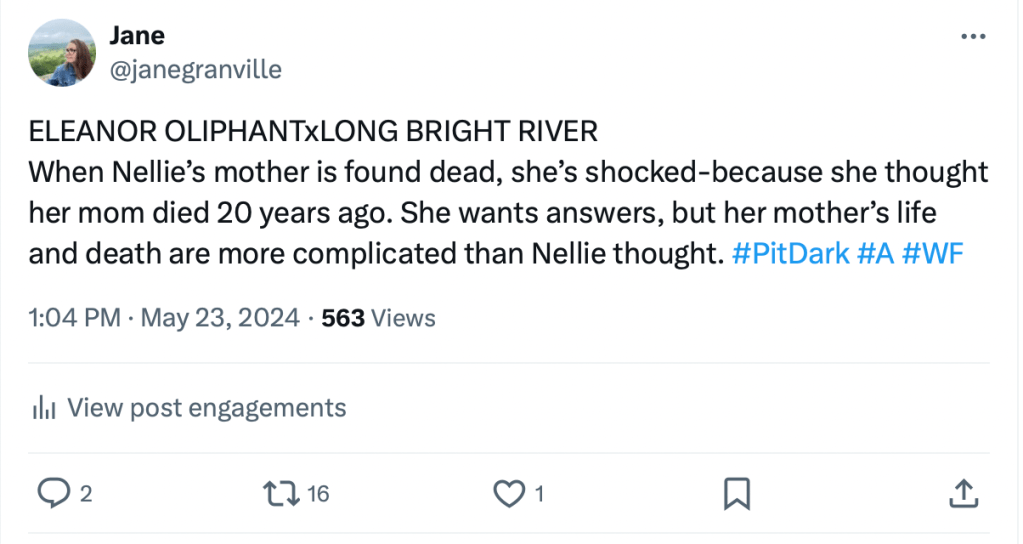
(see that little heart?)
I hadn’t had much luck in Pitch contests previously. But this one– a like! From a small publisher.
Interesting.
At this point– over a year and 100 queries into my journey– I had not yet really considered small presses. I had traditional publishing dreams, and to me that meant the first step was an agent. I was wary of small presses after hearing some horror stories, including predatory vanity presses or small publishers who fold days before someone goes to print, go AWOL and leave authors and their rights in limbo. (Of course, there are agent horror stories too, and for every horror story there are plenty of situations that are totally fine!) But that meant I had never really considered submitting to small publishers unagented, and knew little about the process or what to look out for–both the red or the green flags.
After some research, I decided to query the publisher who liked my pitch. Then I got back to chasing down my visa, selling furniture, and packing up 3 years of my life.
A full request on July 3, a couple of weeks after I’d arrived in the UK. And on July 23, I woke up to the offer email.
The Numbers
Some stats, if you are interested:
Queries: 138 (I think- I might have missed a few untracked queries!), 137 agents and 1 publisher
Rejections: 83
CNR: 48
Full Requests: 5 (4 agents, 1 publisher; 1 agent request came after nudging about the offer)
Partial Requests: 2
Offers: 1
Time from first query to offer: 536 days
Lessons
I don’t know that I have advice, per se. I won’t tell you what your publishing path should look like. Am I glad that I didn’t shelve this manuscript, despite wondering several times if I should? Yes. Do I think my experience is a roadmap that others should follow? No. Because everyone’s situation is different, and what was right for me might not be right for you. If I have advice, it’s on process, not outcome, and these are by no means golden rules! They are only things that I found important parts of my process, that I hope might help you in yours.
I needed to ask myself what was important. An offer from a publisher was not what I was seeking! Between my initial call with the publisher and accepting the contract, I spent a lot of time considering what I wanted. That feels like it should be an obvious question– what had I been doing for the past year and a half?-but there is more than one way to get your book on a shelf. I know that publishing with a small press will look different than if I’d signed with an agent and gotten a publishing deal with a Big Five publisher. But… is that a bad thing? A pitch contest like led me toward a path I hadn’t really considered, and in doing so helped me clarify my own goals, values, and what was important to me in publishing.
Vetting and research helped me feel confident in my choice. After receiving my offer, my first reaction was not, surprisingly, elation. It was anxiety. What if I choose the wrong thing? I had worked so hard for this day, but I also knew I did not want to just take the first offer if it did not serve me or my book. I did a lot of googling. I reached out to some writer friends on Twitter. I emailed authors working with the publisher. I used the Authors Guild contract template and compared my contract with that one, section by section, reading their guidance on what sections mean and what is favorable or unfavorable to the author. I also hired an agent as a consultant to review the contract for me and offer her feedback. This is, of course, an out-of-pocket expense, unlike the typical arrangement when an agent represents an author in which they receive a commission when they sell your book. I have the privilege of being able to afford this, and if you are financially able, it is something I recommend– especially for newbies, like me. It was so helpful to get an industry professional’s input, and hearing her say, “I would sign this contract,” gave me the confidence to do so. But, even if this isn’t in your budget, the Author’s Guild resource was enormously helpful in breaking down the contract and understanding what I was reading. They offer legal review, if you want to join as a member, but reading their contract template is free to access and review.
Community kept me sane. I am an anxious introvert, and even after a year and a half on Twitter I haven’t made too many close connections (though I am forever grateful for my twitter bestie Berna and the fact that the algorithm gods connected us shortly after I rejoined Twitter). But having people to vent to, ask questions, get encouragement, and bounce ideas off of is invaluable. I met my in-person writing group members in Germany through an international expat women’s group that hosted events. One of those events was a writing salon. Sadly, I had to say goodbye to this group when I left Germany, but this week I am attending a writing workshop in my small-ish town in England. I have no idea how it will go! But man, I was excited when I saw the poster on a shop window.
I tried to focus on what was in my control. This is something I tell my therapy clients all the time, and it’s something I needed to be reminded of, myself, several times. Around New Year’s Eve, my husband asked what I wanted to get out of 2024. I said an agent and a book deal. He suggested I reframe this into something within my control. I thought about it, and said, “Work hard, keep learning, and not give up.” I like to think I did all three, and while I don’t have an agent, I do now have a book deal.
I stayed willing to assess, learn, and revise. My manuscript now is significantly stronger than it was when I started. I wrote a book a few years out from any of the creative writing classes I’d taken in college, knowing little about the business of publishing post-COVID. I have seen some people say that once you start querying, you should stop revising– that you shouldn’t query at all until you know it is 100% done. Is that good advice? I don’t know, maybe. (See earlier comment about how I queried way too early.) Is it realistic advice? I don’t think so. I tried not to be constantly tinkering and making small changes between every query I sent off, but there were multiple points in this process that I realized that something wasn’t working and I pulled out, assessed, got feedback, and went back in to revise.
This is probably why my time in the “trenches” is, perhaps, longer than most for one manuscript. Lots of people have been querying for longer; but, in my anecdotal observation, this seems to be spread across several books. Perhaps I stuck with this one–my first– longer than others would have. Because I took several pauses to reassess and revise, it probably took me longer to get to, say, 100 agents than other people. But if I hadn’t been willing to ask myself, “What’s not working? What do I need to change?” I probably would have ended up shelving this manuscript.
Final Thoughts
Every author’s journey is unique and I wouldn’t want to tell anyone what theirs should look like, but I hope mine gives some light for people who are stuck in the darkness of querying right now. My “yes” came from somewhere unexpected. Who knows where yours might come from?
-jane

 Jane Granville
Leave a comment